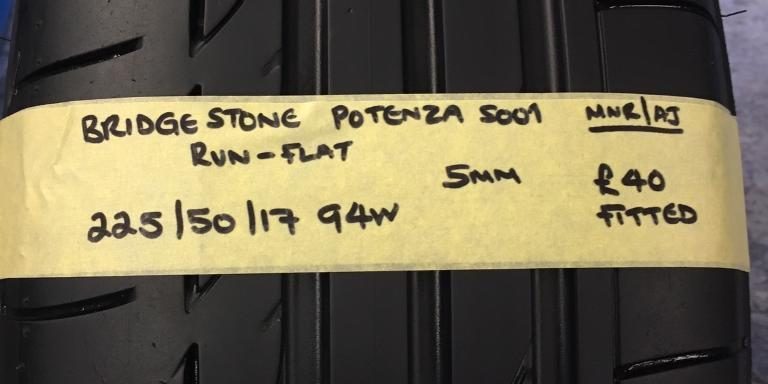
Run-Flat technology was designed to enable the vehicle to continue to be driven with punctured tires.
Run-Flat tires can continue moving in less than 90 km/h speed and for 16 to 80 kilotmeters on average.
There are already 3 main types of Run-flat tires:
Self-Supporting: These tires were designed in 1930 in order to decrease the possibility of blowouts in dangerous situations. Increasing resistance with one addidtional fabric lining,
Nowadays self-supporting tires utilizes a more advanced inner structure to achieve more stability in air loss conditions.
Self – supporting Bridgestone tires, made it possible for BMW and other automakers to design cars with no spare tires.
Self-Sealing: this technology uses an additional lining in order to self-seal the tire in situations like screw or nail holes. Besides there are other ways to achieve the same result in this technology. For example, in some tires specific compounds get injected through the tire valve and rotating force distributes the compound onto the inner surface to act as a self-sealing lining.
Support-Ring: these tires use rubber or another hard structure to withstand the whole weigth, so if anything happens to the tire and it loses air, it can keep moving. In the newer models, driver may not even notice any difference, so the car needs a tire pressure monitoring system to utilize these tires. Military and high-level executive protection vehicles usually use this technology because of the safety level provided.